
Criminal Court Records in Cimarron County
A criminal court record is the case file a court clerk opens once the state files charges against a person. In Cimarron County, the Court Clerk at the courthouse in Boise City keeps these files for the District Court. The record is built one entry at a time. It starts with the charging document and the case number. It then gathers bonds, court settings, pleas, orders, and the judgment. Felony case numbers in Oklahoma carry the prefix CF. Misdemeanor case numbers carry the prefix CM. Both kinds of cases live in the same District Court system. For a closer look at the charges a prosecutor files, the Cimarron County arrest records and court charges page breaks that part down.
Oklahoma runs its trial courts at the district level. Each of the state's 77 counties has a District Court, and Cimarron County's sits in Boise City. The District Court handles both felony and misdemeanor charges, so there is no separate criminal court to search. A felony is the more serious class, and it often begins with a preliminary hearing to test probable cause. A misdemeanor carries lighter penalties and usually moves faster. City ordinance and municipal traffic matters are handled by a municipal court, not the District Court, so a city case will not show up in the county criminal file.
How to Search Cimarron County Criminal Court Records
Most Cimarron County criminal court records can be searched online for free. The Oklahoma State Courts Network, known as OSCN, hosts district court dockets and case-number lookups. On Demand Court Records, or ODCR, gives a second path and lists Cimarron County among its participating courts. ODCR reports that Cimarron records have been online since July 18, 2001 and refresh every hour. For a felony or misdemeanor, both sites can show the charges, the docket, and the disposition once the case is entered.
- Open OSCN or ODCR and choose Cimarron County District Court.
- Search by the defendant's name or by a case number in Oklahoma format, such as CF-2025-00002.
- Narrow the search by court, case type, or a filed-date range when the name is common.
- Open the case to read the docket, the charges, and the disposition entry.
- Ask the Court Clerk at (580) 544-2221 for a certified copy when you need an official document.
OSCN warns that its online case pages are a public convenience and not the official record. The Court Clerk holds the certified file and answers questions about sealed cases. For someone already sentenced to state prison, the Oklahoma Department of Corrections runs a separate offender lookup that reaches beyond a single county.
The statewide sentenced-offender search is published through the Oklahoma Department of Corrections offender lookup.
That agency cautions its data is abbreviated and not an exact explanation of the offense or sentence, so the Cimarron County court file stays the better source for the full criminal record. Other case types beyond criminal matters sit on the broader Cimarron County court records page.
Stages of a Cimarron County Criminal Case
A criminal case moves through set stages, and each one leaves a mark in the record. The flow below shows the usual order. Reading the docket in that order helps make sense of what happened and when.
Case flow: Charges Filed › Arraignment › Pretrial / Motions › Plea or Trial › Disposition › Sentencing
| Stage | What Happens |
|---|---|
| Arraignment | The defendant first appears, hears the charges, and enters a plea. Bond terms are often set or reviewed here. |
| Pretrial / Motions | Lawyers file motions, trade evidence, and argue legal questions. Many cases end in a plea at this stage. |
| Plea or Trial | The defendant pleads guilty or no contest, or the case goes to trial before a judge or jury that decides guilt. |
| Sentencing | After a plea or verdict, the judge sets the punishment. It may include jail, prison, probation, fines, or costs. |
Felony cases add a step that misdemeanors skip. A felony usually goes through a preliminary hearing, where a judge decides whether there is enough evidence to bind the case over for trial. Each setting and ruling lands in the docket as a dated event.
What a Cimarron County Criminal Court Record Shows
Cimarron County criminal court records follow a common layout. Each file opens with a caption that names the State of Oklahoma as the party against the defendant. From there the record fills in the charge, the parties, and the case events. The fields below appear on most public case pages.
| Field | What It Shows |
|---|---|
| Case Number | The unique court ID, such as CF-2025-00002, built from a prefix, year, and sequence. |
| Defendant | The person charged. The State of Oklahoma is the opposing party. |
| Charges | Each count, the statute cited, and the level, felony or misdemeanor. |
| Plea | The defendant's response to each count: guilty, not guilty, or no contest. |
| Disposition | The outcome of each count, such as convicted, dismissed, or acquitted. |
| Sentence | The penalty imposed, including jail, prison, probation, fines, and court costs. |
Beyond those core fields, a criminal file often records more detail about how the case ran:
- Arresting agency and officer, such as the sheriff's office or the Oklahoma Highway Patrol.
- Bond amount and type, plus any forfeiture.
- Hearing and appearance dates.
- Court costs, fines, restitution, and statutory assessments.
- Warrant entries, including bench warrants for failure to appear.
- Document links when the clerk has attached filings.
Public displays leave out sensitive identifiers. Social Security numbers, full dates of birth, and confidential juvenile details do not appear in the open docket.
Charges and Convictions in Cimarron County Cases
Being charged is not the same as being convicted. A charge is an accusation. A conviction is a finding of guilt by plea or verdict. A Cimarron County criminal record can show charges that were later dropped, dismissed, or that ended in an acquittal. Reading only the charge can give a false picture, so always check the disposition for each count.
| Charge | Conviction | |
|---|---|---|
| Stage | Accusation | Verdict or plea |
| Burden of Proof | Probable cause | Beyond reasonable doubt |
| Public Record | Yes | Yes |
The gap matters for anyone reviewing a file. A felony charge filed under a CF case number may have been reduced to a misdemeanor, or dismissed in full, before the case closed. The final disposition is the part that controls.
Reading Dispositions and Sentences in Cimarron County
The disposition is the final outcome the court enters for each count. Common entries include guilty, not guilty, dismissed, and nolo contendere, which means no contest. A deferred sentence delays judgment and can end in dismissal if the defendant meets every condition. A suspended sentence holds back jail or prison time as long as the terms are kept.
- Deferred sentence
- Judgment is delayed; the charge can be dismissed if the conditions are completed.
- Suspended sentence
- Jail or prison time is held back while the person follows the court's terms.
- Nolo contendere
- A no-contest plea that is treated like a guilty plea for sentencing.
- Restitution
- Money the court orders a defendant to repay a victim.
Sentences are read count by count. One case can carry several counts, each with its own outcome and penalty.
Prosecution and Defense in Cimarron County
The State of Oklahoma prosecutes criminal cases through the District Attorney. Cimarron County sits in Prosecutorial District 1 with Beaver, Harper, and Texas Counties. District Attorney George Leach leads that office. The District Attorney reviews law-enforcement reports, decides what charges to file, handles plea talks, and represents the state in court. The District 1 office works out of Guymon, and the prosecutor often appears in the case record as a named party or attorney.
District Attorney, District 1
Texas County District Attorney's Office
319 N. Main, Guymon, OK 73942
(580) 338-3388
A defendant who cannot afford a lawyer may be assigned counsel. The Oklahoma Indigent Defense System covers Cimarron County through its Guymon satellite office. A judge decides whether a defendant qualifies as indigent before counsel is appointed.
The counties served by the appointed-defense office are listed on the Oklahoma Indigent Defense System Cimarron County page.
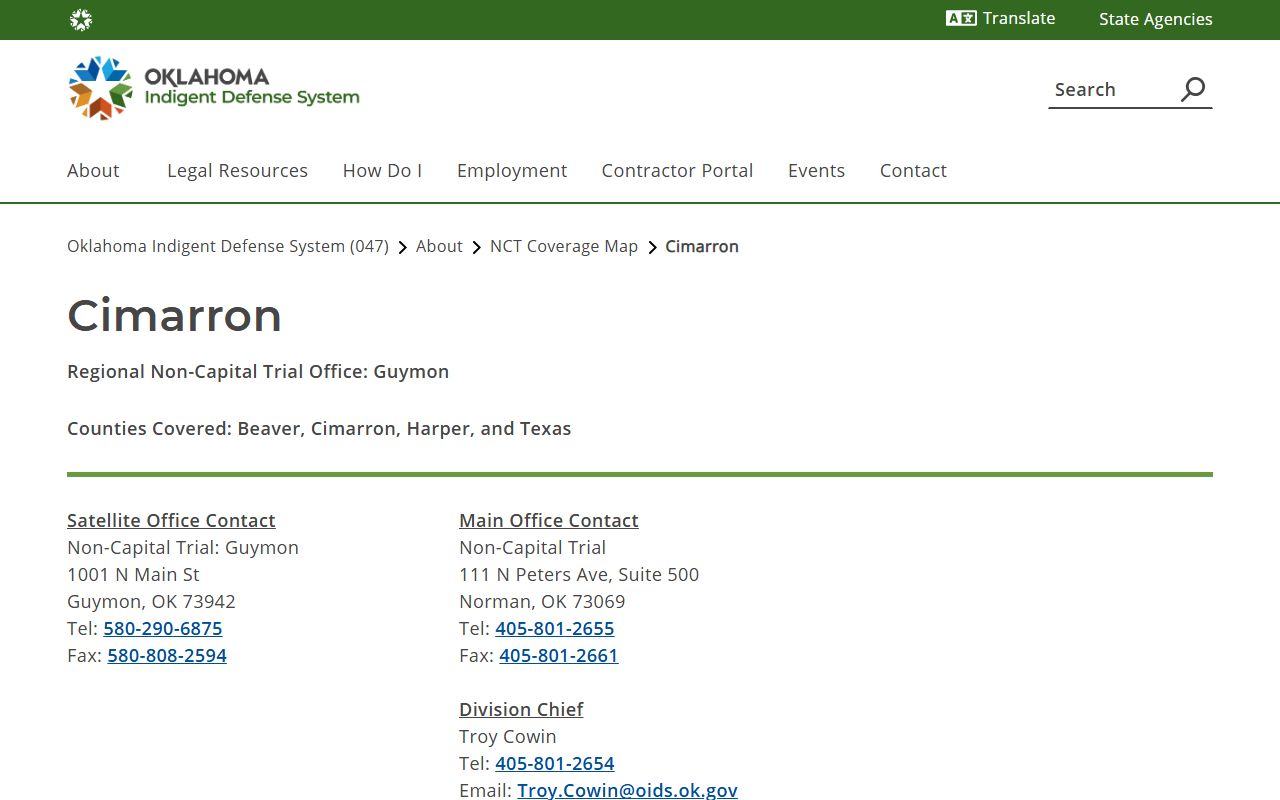
That coverage means a criminal court record may list an appointed attorney as defense counsel when the court has found the defendant unable to pay.
Sealed vs. Expunged Records
Some criminal records are removed from public view. Sealing hides a record from public searches. Expungement goes further and treats the record as though it never existed. Oklahoma sets both processes by statute. Adult criminal expungement runs through 22 O.S. Sections 18 and 19, which list who qualifies and how to file. Juvenile records follow separate rules under Title 10A.
| Sealed | Expunged | |
|---|---|---|
| Visibility | Hidden from public | Destroyed / treated as never existed |
| Law Enforcement | Limited access | Very limited |
| Eligibility | By court order under Oklahoma law | Meets 22 O.S. § 18 / § 19 criteria |
An expungement in Oklahoma needs a court filing and a signed order. There is no automatic erasure, and a person usually must give notice to the District Attorney and the agencies that hold the records.
Public Access to Cimarron County Criminal Court Records
Oklahoma treats most court records as open to the public. The Oklahoma Open Records Act sets the baseline rule that public bodies must release records unless a law makes them confidential. Criminal case files in Cimarron County fall under that rule, so the docket, charges, and disposition are generally open. The Court Clerk is the office that certifies copies and answers questions about sealed files.
Key Statutes:
Oklahoma Open Records Act, 51 O.S. § 24A.1 - public bodies must make records open unless a law closes them.
51 O.S. § 24A.5 - ordinary records are open for inspection and copying, while confidential categories stay closed.
22 O.S. § 18 - sets the eligibility and procedure for adult criminal expungement.
Oklahoma appellate rules add one caution. Court of Criminal Appeals Rule 2.6 states the OSCN online search is a public convenience and does not replace the court's official case-management record.
Background Check Considerations
A casual record lookup is not the same as a formal background check. Court records can show charges, but they may miss a sealed case, a pending appeal, or a recent update. Employers, landlords, and licensing bodies that run background checks must follow the federal Fair Credit Reporting Act. That law sets rules for how criminal data may be used in those decisions.
Important: This site is not a consumer reporting agency under the FCRA, and its records cannot be used for credit, employment, housing, or other FCRA-regulated decisions.
Restricted Criminal Court Records in Cimarron County
Not every criminal record is open. Juvenile cases are confidential under Oklahoma law and do not appear in ordinary public dockets. Sealed and expunged cases drop out of public view once a judge signs the order. Active investigations, grand jury matters, and some warrant records may be withheld while a case is open. Personal identifiers such as Social Security numbers and full dates of birth are redacted from public displays. For a sealed-record question or an older file that is not online, the Court Clerk in Boise City is the office to call.