
No Public Warrant Portal in Cimarron County
Warrants in Cimarron County are issued by a judge of the District Court in Boise City. A judge signs an arrest warrant when law enforcement or the District Attorney shows probable cause that a person committed a crime. Judges also issue bench warrants and capias orders when a person misses a court date or ignores a court order. Each of these warrants is tied to a court file, which is why the court clerk and the online dockets matter so much for a real answer.
There is no separate official Cimarron County active-warrant website to type a name into. The Sheriff's Office site posts a Most Wanted page, a Sex Offenders page, and a Violent Offenders page, but those are not the same as a live warrant list. During review, the Most Wanted and Sex Offenders pages asked visitors to pass a verification step, and the Violent Offenders page loaded with no listed people. Because no single database answers the question, the smart move is to work the chain of offices below in order.
That chain starts with a phone call and ends, if needed, with a written request. It costs nothing to ask, and a five-minute call to the right office usually beats an hour of guessing.
How to Check for a Cimarron County Warrant
The fastest route depends on the kind of warrant you think exists. A failure-to-appear on a traffic ticket lives in a court file. A street-level arrest warrant may sit with the sheriff. Work these steps in order until you get a clear answer.
- Call the Cimarron County Sheriff's Office at (580) 544-2020 for most-wanted or warrant information the website does not show. If the matter is urgent or someone is in danger, call 911 instead.
- Call the Court Clerk at (580) 544-2221 for bench warrants, failure-to-appear warrants, and capias entries that appear in a District Court case.
- Search the online court dockets at OSCN and ODCR by name or case number. Public records may show a warrant issued, a warrant recalled, or a bond forfeiture event.
- Check the municipal court of the city that wrote the ticket for any city ordinance or municipal traffic warrant, since the state court search does not cover those.
- File a Sheriff's Office records request when you need a copy of a report or document, then pick it up in person at 409 N Logan.
- Check the statewide Oklahoma Department of Corrections lookup and the U.S. Marshals for state corrections fugitives or federal warrants.
Cimarron County Sheriff's Office Warrant Contact
The Sheriff's Office and the county jail share one address and one main line, separate from the courthouse. A deputy or jail staffer can tell you whether a name shows on a current warrant or most-wanted entry that the public website does not display. Calling first is also safer than walking into the lobby, especially when you are not sure of the warrant status.
Cimarron County Sheriff's Office
409 N Logan
Boise City, OK 73933
(580) 544-2020
Normal business hours, weekdays
Sheriff Mark Swinton leads the office, which also runs the Cimarron County Justice Center where the jail sits. The same number reaches the jail for custody questions, while warrant and report questions go to the records side of the office.
Court Dockets That Show Warrant Activity
Many warrants surface in the public court record before anyone else posts them. When a judge issues a bench warrant for a missed hearing, that event is logged in the case docket. The two free systems that carry Cimarron County District Court cases are the Oklahoma State Courts Network and On Demand Court Records. Both let you search by name or case number at no cost.
Open a criminal or traffic case and read the event log. Entries such as warrant issued, warrant recalled, failure to appear, bond forfeiture, and contempt all point to warrant activity on that file. ODCR's status page confirms Cimarron records have been online since July 18, 2001, and update each hour, so the dockets stay current. A warrant connected to a criminal charge sits inside the full Cimarron County criminal court records, where the underlying counts and any later disposition also appear.
Online pages are a public convenience, not the official file. The Court Clerk keeps the controlling record.
Note: An online docket can lag a real courtroom event, so confirm any warrant status with the Court Clerk before you rely on what a screen shows.
Types of Warrants in Cimarron County
Not every warrant means the same thing. The reason a warrant was issued shapes how you resolve it and which office to call. These are the common kinds tied to Cimarron County cases.
- Arrest warrant: Issued by a judge on a sworn showing of probable cause that a person committed a crime.
- Bench warrant: Issued by a judge from the bench, most often after a person fails to appear for a scheduled hearing.
- Search warrant: Authorizes officers to search a place or item for evidence and is usually not public while an investigation is open.
- Capias or failure-to-appear: An order to bring a person before the court, common when someone skips a traffic or criminal setting.
- Fugitive warrant: Used when a wanted person is sought across county or state lines, often handled with state or federal agencies.
What a Cimarron County Warrant Record Shows
When warrant details are public, the information usually mirrors the court file behind it. A docket entry or a clerk's record can show most of the fields in the table below, while sealed or sensitive matters reveal far less. Use these fields to confirm you are looking at the right person and the right case.
| Field | What It Shows |
|---|---|
| Name | The person the warrant names, used to confirm identity against a case. |
| Case Number | The District Court file the warrant is attached to, such as a CF, CM, or TR case. |
| Issuing Court | The court that signed the warrant, normally the Cimarron County District Court. |
| Warrant Type | Arrest, bench, search, or fugitive, which signals how it must be resolved. |
| Underlying Charge or Citation | The crime, count, or ticket that led to the warrant. |
| Failure-to-Appear or Contempt Basis | The missed hearing or violated order that triggered a bench warrant. |
| Bond Amount and Type | The security set for release, when a bond has been ordered. |
| Issue Date | The date the judge signed the warrant. |
| Recall or Served Date | When the warrant was withdrawn or carried out, if that has happened. |
| Arresting or Serving Agency | The sheriff, police, or other agency tied to the warrant. |
Cimarron County Municipal Court Warrants
City tickets follow a separate track. When a city police officer or code officer writes a citation, that case is filed in the municipal court of that city, not in the District Court. Boise City and other Panhandle towns handle their own ordinance and municipal traffic matters.
This split matters for a warrant check. The state court traffic citation search covers District Court citations only and plainly states that it does not search municipal citations. So a municipal failure-to-appear warrant will not show up in the state dockets. To find it, contact the court clerk of the city that issued the ticket. Not every small town offers an online lookup, so a phone call is often the only reliable path.
Sheriff Records Requests and Sheriff Sales
Some warrant-related documents are not posted anywhere online. The Sheriff's Office handles those through a formal records request. The office explains its records request process for reports and other documents that the website does not show.
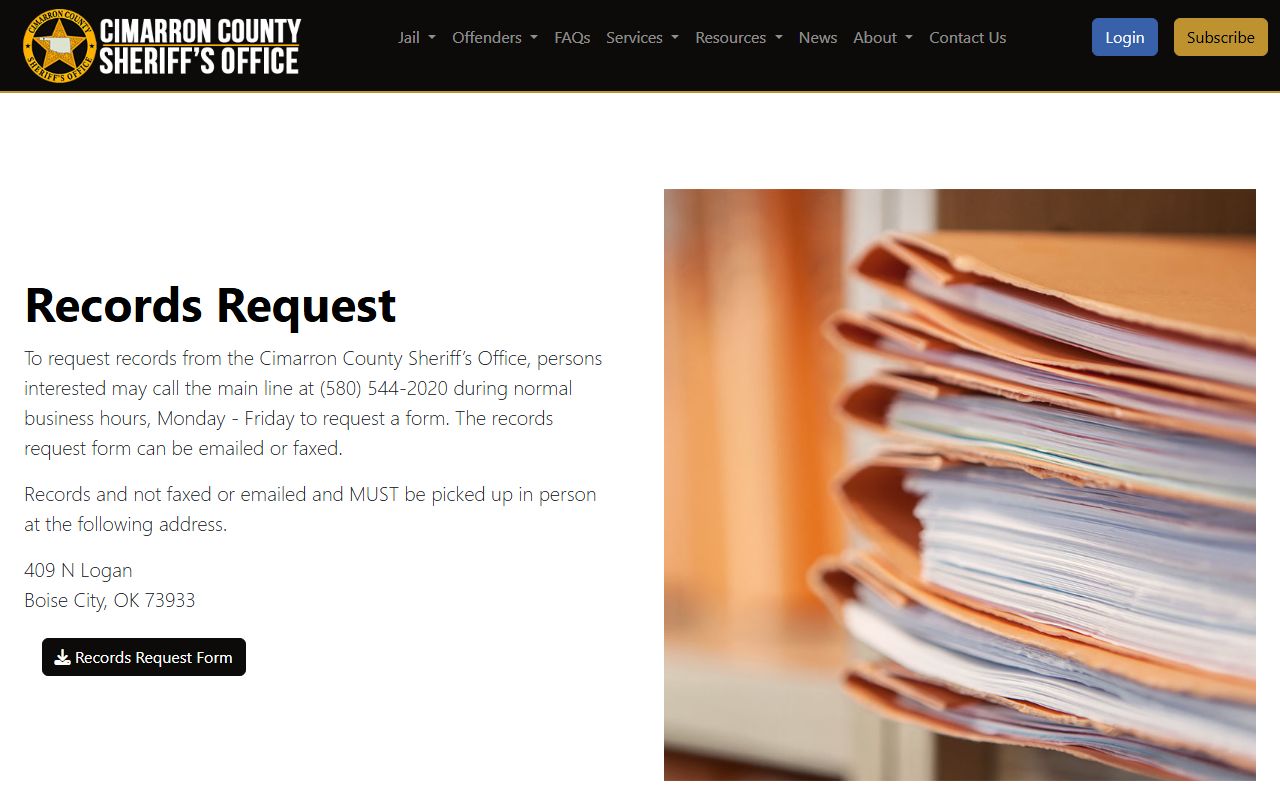
To start, call (580) 544-2020 during normal business hours and ask for the form. Staff can email or fax it to you, but completed records must be picked up in person at 409 N Logan, so plan a trip when a warrant document is involved.
The same office posts its civil enforcement work, which ties back to court judgments. The sheriff sales page shows how a civil judgment can end in a courthouse auction, with sales usually held at the Cimarron County Courthouse.
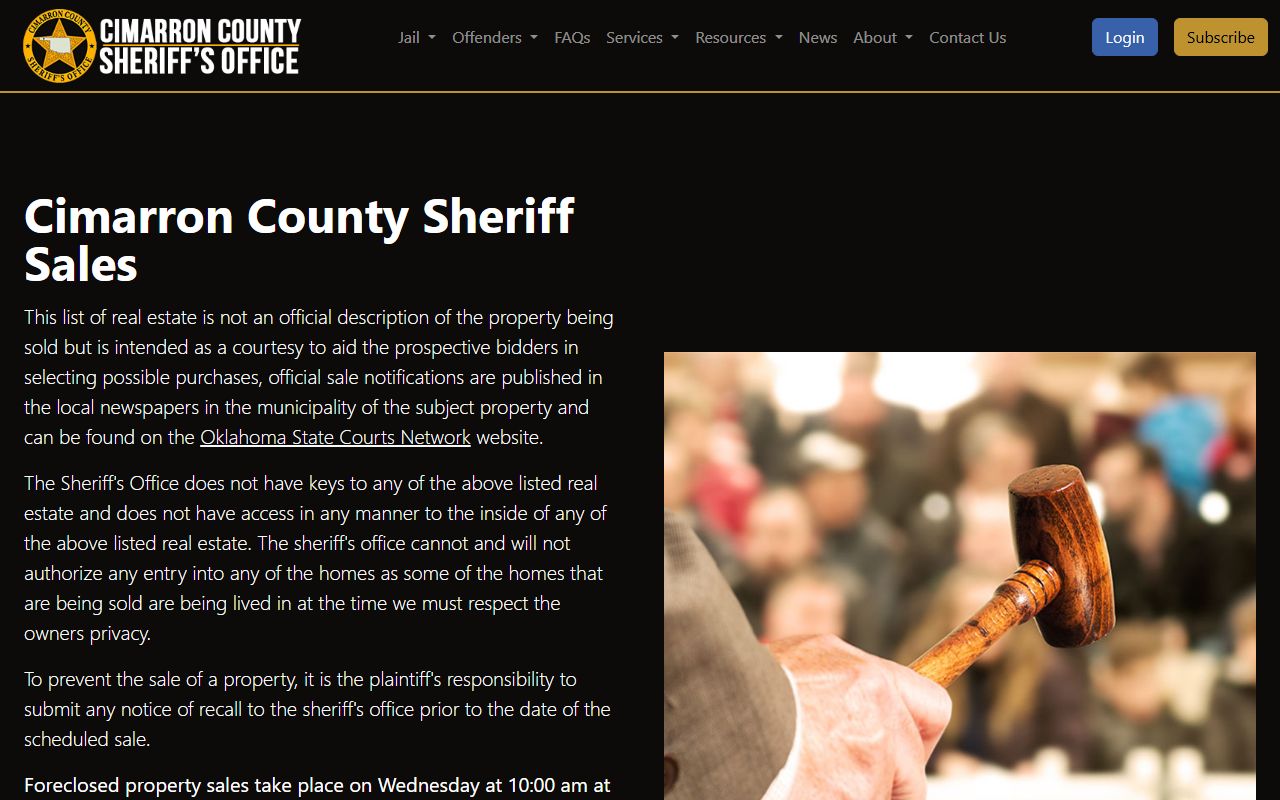
That page is useful context because it shows the sheriff acting on a court order, the same authority behind a warrant. Minimum bids run at two-thirds of appraised value, and payments go to the County Court Clerk.
State and Federal Warrant Checks
A Cimarron County warrant is not always the only one that matters. State and federal systems hold their own records. The Oklahoma Department of Corrections offender lookup can surface people under state supervision, though it warns that its data is abbreviated and not an exact statement of a sentence. For federal warrants and fugitives, the U.S. Marshals Service Western District of Oklahoma covers Cimarron County.
Custody tools are sometimes confused with warrant tools, so it helps to draw the line. Oklahoma's VINE notification portal tracks custody status rather than open warrants.

VINE tells you whether someone is booked, released, or transferred, and it can send alerts. It does not list who has an open warrant. If you want booking and custody detail instead, the Cimarron County inmate records page covers the jail roster and notification setup.
Note: The Violent Offenders page on the sheriff site cites the Oklahoma Mary Rippy Act at 57 O.S. Sections 591 through 599, which governs violent-offender registration rather than active warrants.
What to Do About a Cimarron County Warrant
Finding a warrant in your own name is stressful, but ignoring it almost always makes things worse. A bench warrant can sit open for years and surface at a traffic stop. The steps below help you resolve it the right way.
- Identify which court or agency issued the warrant, and do not rely on third-party lists to make that call.
- Contact the Court Clerk or the Sheriff's Office to confirm the warrant and ask whether a bond is set.
- Ask what payment methods the office accepts and what the clerk needs to recall a failure-to-appear warrant.
- Consider speaking with an attorney before you appear, since counsel can sometimes arrange terms in advance.
- Appear at the courthouse or jail as directed, then ask for written proof that the warrant was recalled or quashed.
- Confirm later that the online dockets updated to reflect the recall.
Important: Talk with a lawyer before you turn yourself in on a serious warrant, because the bond, charge, and timing can affect how long you stay in custody.
Sealed and Juvenile Cimarron County Warrants
Some warrants never reach the public eye. A search warrant connected to an open investigation is usually shielded so it does not tip off a suspect. Juvenile warrants are confidential under Oklahoma juvenile law and are not searched the way ordinary adult cases are.
Sealed and expunged matters drop out of public view as well. When a court seals or expunges a case, the warrant tied to it may vanish from the docket or appear only in limited form. Confidential victim information, protected addresses, and personal identifiers are also redacted from public displays. For any of these restricted records, the Court Clerk is the office that can explain what, if anything, is available and through what process.