
Cimarron County District Court in Oklahoma's System
Oklahoma's general trial court is the District Court. There are 77 of them, one for each county, and each one handles a wide range of cases. The court for this county sits in Boise City, the county seat. It hears felony and misdemeanor crimes, civil suits, small claims, probate, family and divorce matters, protective orders, juvenile cases, and traffic tickets filed at the district level. In short, most legal disputes that start in the county begin their life on this court's docket.
Oklahoma is set up in an unusual way at the top. The state has two courts of last resort, not one. The Oklahoma Supreme Court has the final word on civil cases. The Oklahoma Court of Criminal Appeals has the final word on crimes. Civil appeals can also pass through the Court of Civil Appeals on the way up. Below the District Court, municipal courts handle city ordinance violations and municipal traffic.
That split between civil and criminal high courts is rare. Only one other state shares it. For Cimarron County filers, it mostly matters at appeal time, when the path forward depends on the kind of case.
Courts and Offices Serving Cimarron County
Cimarron County has no numbered district courts the way large metro counties do. A single District Court serves the whole county, and the work is split across a handful of offices rather than many separate courtrooms. The table below lists the trial court, the two clerks who keep different sets of records, the Sheriff's Office, and the two state courts that sit above the District Court. Court case files, probate, divorce, marriage records, and traffic payments run through the Court Clerk. Recorded land instruments run through the County Clerk.
| Court / Office | Role | Address | Phone |
|---|---|---|---|
| Cimarron County District Court | General trial court for civil, criminal, probate, family, small claims, and district traffic cases | 1 Courthouse Square / Main Street, Boise City, OK 73933; mail P.O. Box 788 | (580) 544-2221 |
| Cimarron County Court Clerk | Court record keeper and payment or copy office | Courthouse Square / Main St., Boise City, OK 73933 | (580) 544-2221; fax (580) 544-2006 |
| Cimarron County Clerk | Recorded instruments and land records | Courthouse, P.O. Box 145, Boise City, OK 73933-0145 | (580) 544-2251 |
| Cimarron County Sheriff / Justice Center | Jail, booking, inmate search, sheriff records, and sales | 409 N Logan, Boise City, OK 73933 | (580) 544-2020 |
| Oklahoma Supreme Court | State civil court of last resort | 2100 N. Lincoln Blvd., Oklahoma City, OK 73105 | OSCN contact online |
| Oklahoma Court of Criminal Appeals | State criminal court of last resort | Oklahoma Judicial Center, Oklahoma City | See OKCCA |
Public records users should keep the courthouse and the Sheriff's Office separate in their minds. The courthouse holds the court and the clerks. The justice center on North Logan holds the jail and booking records. Each answers a different phone line.
Cimarron County District Court vs. Municipal Court
The lower court in Oklahoma is the municipal court, run by a city rather than the county. It is easy to mix the two up, but they do not handle the same things. The District Court is a court of general jurisdiction, so it can hear almost any case allowed by law. A municipal court is limited to city ordinance violations and municipal traffic, such as a speeding ticket written inside town limits by city police. The comparison below shows where each line is drawn.
| District Court | Municipal Court | |
|---|---|---|
| Case Types | Felony, misdemeanor, civil, small claims, probate, family, juvenile, district traffic | City ordinance violations, municipal traffic, local code matters |
| Court Level | General jurisdiction trial court for the county | City-level court of limited jurisdiction |
| Where Filed | Cimarron County Courthouse in Boise City | The city that issued the citation or charge |
| Appeal Route | State appellate courts in Oklahoma City | Varies; many cases route to District Court |
| Records Access | OSCN and ODCR online, plus the Court Clerk | City clerk; many towns have no online lookup |
The practical lesson is simple. Match the ticket or filing to the court that issued it. A state trooper or sheriff citation usually lands in District Court. A city police ticket usually lands in that city's municipal court.
Note: Oklahoma's online court system warns that a district court traffic citation search does not return municipal citations, so a missing case may simply be sitting in a city court instead.
How a Case Moves Through the Cimarron County Courts
Most cases start and finish at the District Court level. A case only climbs higher if a party files an appeal. The route up depends on whether the dispute is civil or criminal, because Oklahoma splits its top courts by subject. The flow below traces both kinds of cases from the trial court to the courts that can review them.
Appeal route: Municipal Court or District Court › Court of Civil Appeals or Court of Criminal Appeals › Oklahoma Supreme Court (civil) or Oklahoma Court of Criminal Appeals (criminal)
Inside a single case, the stages run in order. A criminal case and a civil case each follow their own track before any appeal is even possible.
Criminal stages: Arrest › First Appearance › Charges Filed by the District Attorney › Arraignment › Preliminary Hearing › Pretrial › Plea or Trial › Disposition and Sentencing
Civil stages: Petition Filed › Answer › Discovery › Motions › Trial › Judgment › Post-judgment Enforcement
A criminal appeal goes straight to the Oklahoma Court of Criminal Appeals, which has the last word. A civil appeal may be assigned to the Court of Civil Appeals first, then reviewed by the Oklahoma Supreme Court. Municipal cases follow their own appeal rules, and many of them route through the District Court.
What the Cimarron County District Court Handles
Because it is a general trial court, the District Court covers a long list of case types under one roof. There are no separate civil, family, and criminal buildings here. The same court and clerk handle each kind of matter, sorted by case prefix rather than by division. Inspected Cimarron County cases include a traffic file, a small claims file, and a felony file, which shows the spread of work that crosses the docket.
- Felony and misdemeanor crimes, marked with CF or CM case numbers.
- Civil suits and small claims of $5,000 and under.
- Probate, including wills, estates, and guardianships.
- Family law, such as divorce, custody, and support.
- Protective orders and juvenile matters, often with restricted access.
- Traffic cases filed at the district level, marked with TR case numbers.
Small claims belong to the civil side. The inspected small claims case confirms that a dispute of $5,000 or less can be filed right here, decided by the same judge who hears larger matters.
The First Judicial District and Cimarron County
Cimarron County belongs to Oklahoma's First Judicial District, grouped with other Panhandle and northwest counties. The district's local rules note that an associate district judge sits in each county. In Cimarron County, that associate district judge is assigned to hold a miscellaneous docket. The arrangement keeps a local judge available even though the county's caseload is small and its population is among the lowest in the state.
Court records inspected for Cimarron County name Judge Christine M. Larson on traffic and small claims matters. Judge assignments can change, so the name on a future case may differ. The Court Clerk can confirm who is hearing a specific docket before a scheduled appearance.
The structure here is lean. Cimarron County has no separate probate court, so estates and guardianships are handled inside the District Court. There is no county court-at-law like the ones in Texas, and Oklahoma does not use a justice of the peace system. For city tickets or ordinance cases, the municipal court of the issuing city is the place to check.
Cimarron County Courthouse History and Setting
The Cimarron County Courthouse stands at the center of Boise City, on the courthouse square where several U.S. highways converge. The county was created at Oklahoma statehood and is the farthest west of all Oklahoma counties, the only one in the state that touches four neighbors at once. The seat first sat in Kenton around 1907 and 1908 before moving to Boise City. The original courthouse was a wood-frame building from 1908 that later burned.
The Oklahoma Historical Society keeps a detailed entry on the county's geography and past, including Black Mesa, the highest point in the state.
A lead-in worth following is the Oklahoma Historical Society Cimarron County encyclopedia entry, which sets out the county's founding and frontier history.
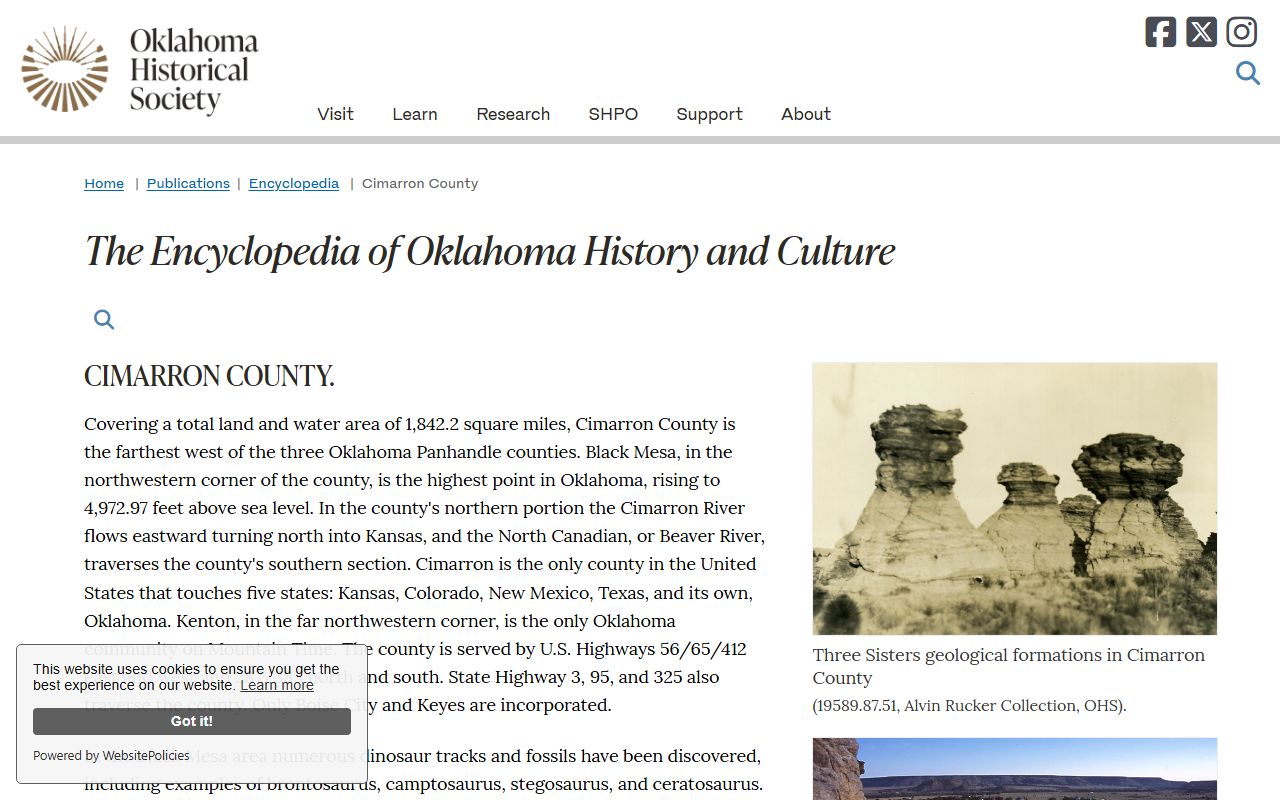
That history explains why the present courthouse, built in 1926 and 1927, became a local landmark. It is a three-story red brick building with neoclassical detail, and it was listed on the National Register of Historic Places on August 23, 1984. The building still houses the District Court for the First Judicial District, along with the county offices that serve Cimarron County records users.
Local heritage runs deeper than the building itself. The National Park Service profiles a nearby museum that interprets the area's frontier and trail history.
For broader context, the National Park Service Cimarron Heritage Center page describes the local museum that preserves regional history.
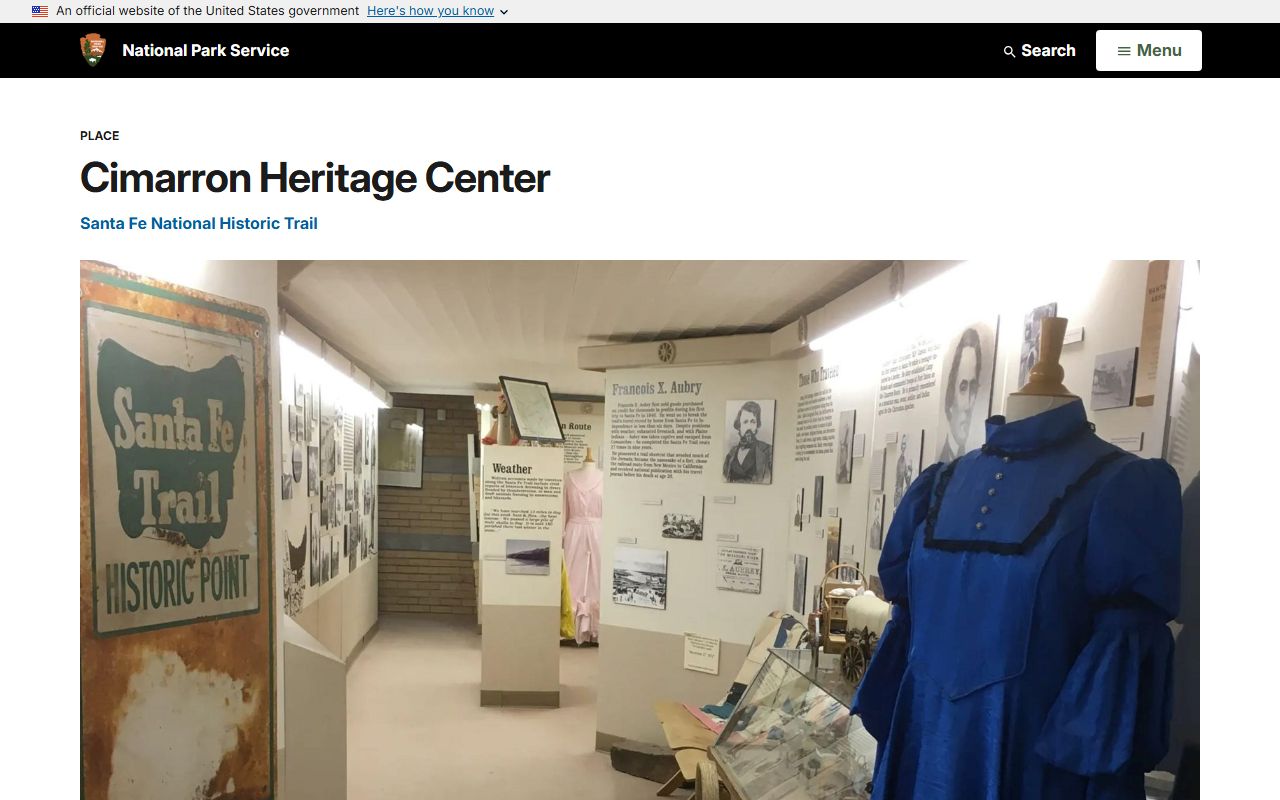
The heritage center sits apart from the courthouse, but it helps visitors understand the county that the District Court serves. Travelers who come for a hearing often pass through the same compact downtown that has anchored county business for a century.
Note: official county sources do not publish courthouse parking, security screening, or accessible-entrance details, so call the Court Clerk before bringing bags or electronics to a hearing.
Federal Courts Beyond the Cimarron County District Court
Some cases never touch the county courthouse at all. Federal crimes, federal civil suits, and bankruptcy filings move through the federal system, which is separate from the Cimarron County District Court. For these matters, Cimarron County falls inside the Western District of Oklahoma. There is no federal courthouse in the county, so filers travel to Oklahoma City or Lawton, or use the online federal record systems.
The trial-level federal court for the region keeps its own offices and case records.
The starting point is the U.S. District Court for the Western District of Oklahoma, which sits in Oklahoma City with a second office in Lawton.
That court hears federal civil and criminal cases for the western half of the state. Its records do not appear on Oklahoma's state court portals, so a search there will not surface a federal file.
Bankruptcy is handled by a separate federal court with its own clerk in Oklahoma City.
People filing or researching a bankruptcy use the U.S. Bankruptcy Court for the Western District of Oklahoma, which lists its hours and counter rules online.
The bankruptcy court lets the public view records free at terminals in the clerk's office. Online viewing runs through the federal access system instead, at a small per-page charge.
The prosecutor in federal criminal cases is the United States Attorney, not the local district attorney.
The office that brings federal charges in the region is the U.S. Attorney's Office for the Western District of Oklahoma, which lists Cimarron among its counties.
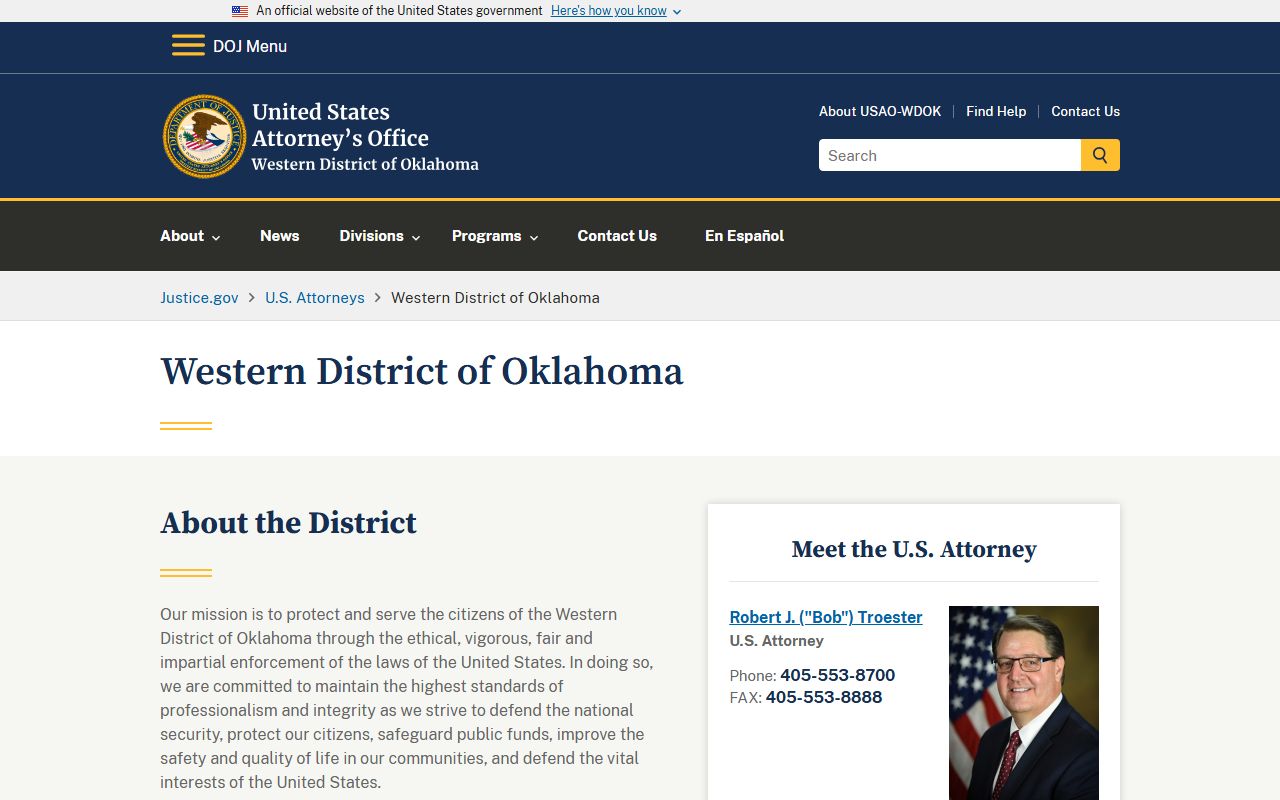
That office handles the federal side of crime in the district, while the Cimarron County District Attorney handles state charges in the county courthouse. The two work on different cases under different law.
Federal court files are searched through one national online system rather than a county portal.
The federal record tool is PACER, shown here for the Oklahoma Western Bankruptcy Court, which connects to each federal court's electronic case files.
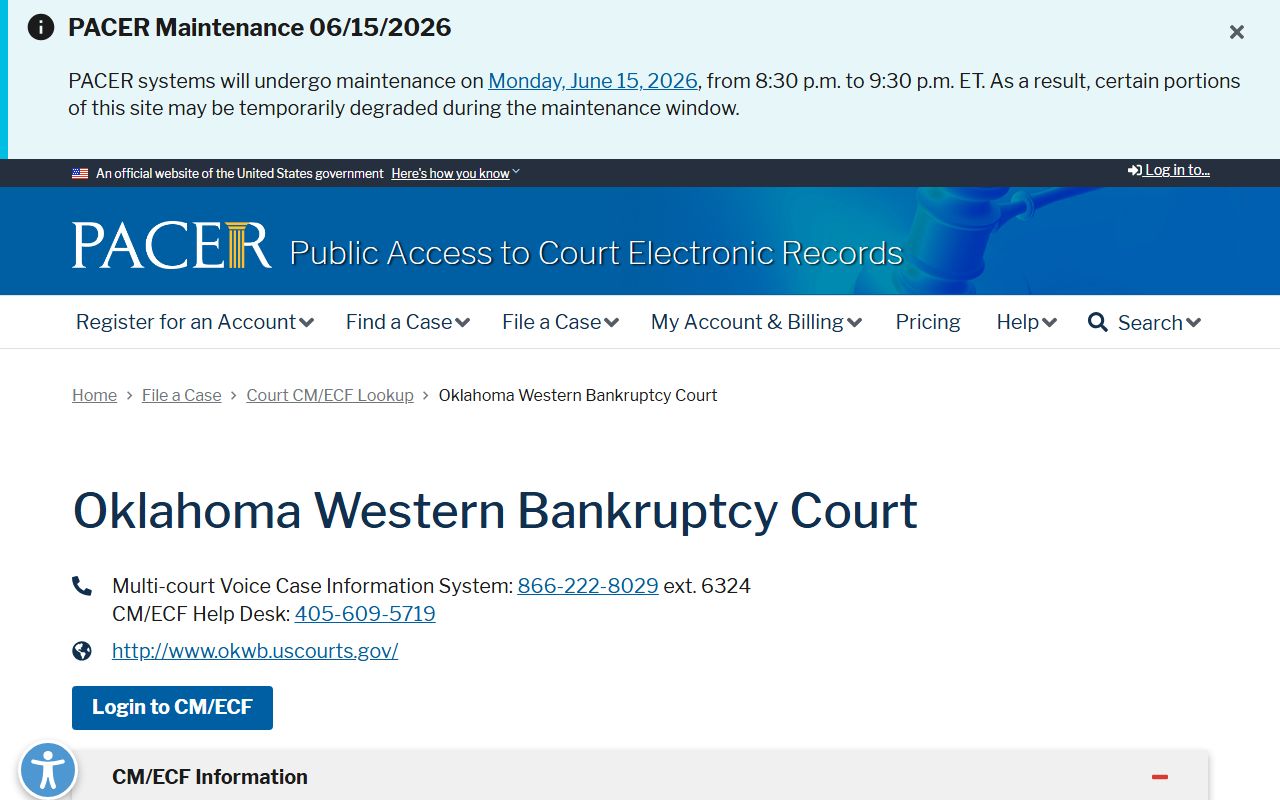
PACER charges a per-page fee with caps and small waivers, and it covers district, bankruptcy, and appellate filings. Federal appeals from Oklahoma go to the Tenth Circuit, while the U.S. Marshals Service for the Western District handles federal warrants. None of these federal records replace the county case files kept by the Court Clerk.
Judges, Dockets, and Diversion in Cimarron County
Day-to-day dockets and judge assignments are the easiest things to check before a court date. Oklahoma's state court system posts case information online, and the local Court Clerk can confirm hearing times, costs, and the official file. Online pages are a convenience copy and not the official court record, so a certified copy still has to come from the clerk. A quick look at the county's court dockets can show upcoming hearings and recent events.
Specialty courts are a known gap here. Research did not locate a confirmed Cimarron County drug court, veterans treatment court, mental health court, or family treatment court. Oklahoma runs problem-solving court programs in many counties, but no specific Cimarron program, judge, or eligibility rule was confirmed in official sources. No such program should be assumed to exist without checking.
Defendants who want to know about diversion, deferred sentences, or treatment options should ask directly. The Court Clerk, the District Attorney for District 1, and the Oklahoma Indigent Defense System are the right offices to call about what a specific case may qualify for. The Court Clerk can also point to the correct form, fee, or filing window for a given record request.
Note: the state warns that online case search is a public convenience and does not replace the District Court's official case-management record kept by the clerk.